Small business health checks are being updated. New purchases are paused while we prepare updated versions of these assessments. Register your interest and we’ll let you know as soon as they are available.
Law Firm
Cyber Security Health Check
Law firms hold the most sensitive information imaginable—and criminals know it.
In about an hour, see exactly where you're exposed, turn your gaps into a prioritised action plan you can track, and get a professional report you can show your insurer, regulator, or clients — no IT knowledge needed.
Your clients trust you with information they wouldn't tell anyone else.
Litigation strategy. Commercial negotiations. Family disputes. Criminal defence matters. The information in your systems is protected by legal professional privilege for good reason—it's extraordinarily sensitive. A data breach doesn't just expose documents; it can destroy privilege, compromise cases, breach confidentiality obligations, and end client relationships built over decades.
Law firms are being held to ransom. Ransomware attacks on legal practices have surged. Criminals know that lawyers will pay to avoid having client matters locked—or worse, leaked. Practices have faced impossible choices: pay the ransom, or watch as privileged client information is published online. The reputational damage alone can be fatal to a firm built on trust and discretion.
Your Law Society and the Privacy Act have real consequences.
Law Societies across Australia now treat cyber security as part of running a competent practice. The Legal Services Commissioner investigates complaints from cyber incidents, and a finding of unsatisfactory professional conduct can suspend or cancel your practising certificate. The Privacy Act adds penalties up to $50 million for failing to protect personal information. "I didn't know" is not a defence.
Your reputation is your practice.
Clients choose lawyers they trust. A cyber incident that exposes client information—even if you're technically a victim—destroys that trust instantly. Word travels fast in legal circles. Referrers stop referring. Corporate clients find new firms. The practice you've spent years building can unravel in weeks. Can you demonstrate you took reasonable steps to protect client information?
Conveyancing fraud is an additional, specific threat.
Beyond ransomware, criminals actively target law firms involved in property transactions. They compromise email accounts, monitor settlements, then send fraudulent payment instructions with altered bank details. Settlement funds vanish—often hundreds of thousands of dollars. Firms have been held liable. Trust accounts have been decimated. This is a daily threat to any practice handling property matters.
Court portals, practice management, document systems—every entry point is a risk.
Think about what's accessible if an attacker compromises one password: court filings, client communications, financial records, matter files going back years. LEAP, SILQ, Actionstep—whatever system you use—needs proper security controls. When did you last check?
This health check is built specifically for legal practices.
Plain-English questions covering the security risks that matter for law firms: privileged information protection, ransomware defences, conveyancing fraud prevention, court portal security, practice management systems, trust account protection, and email security. No technical jargon—designed so any principal or practice manager can complete it.
What you get:
What your results look like
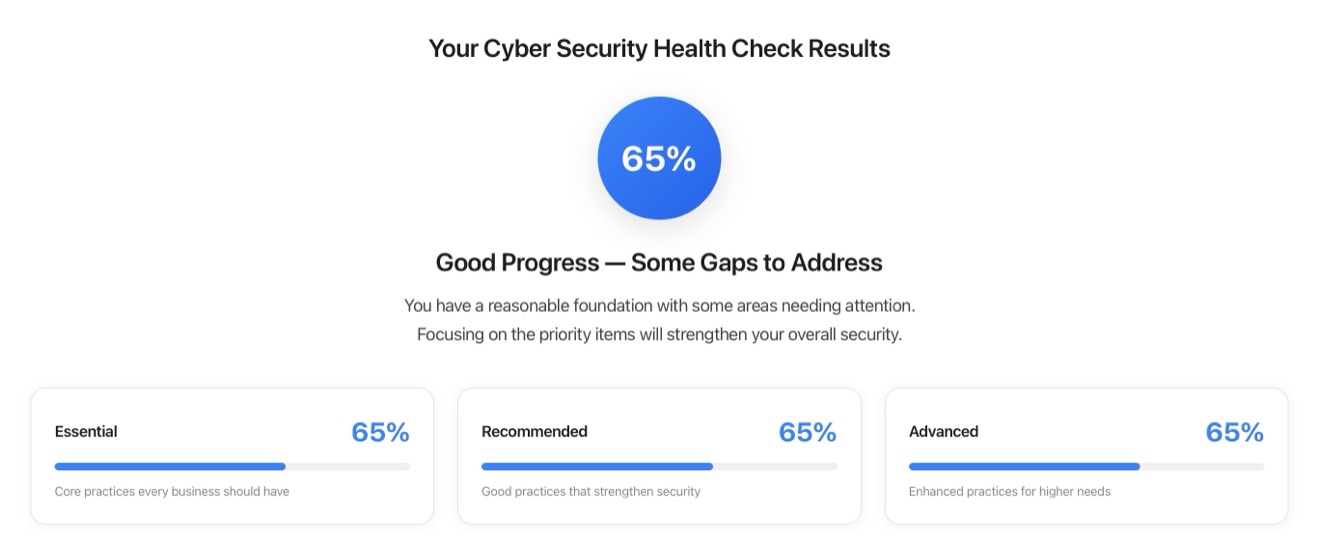
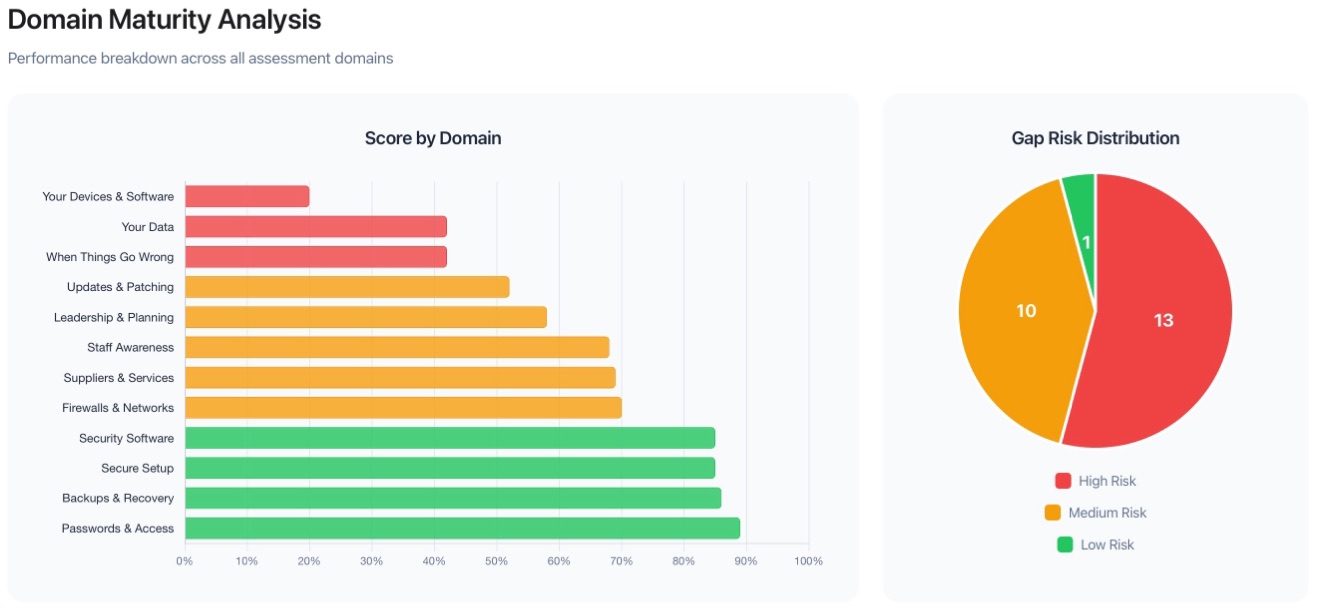
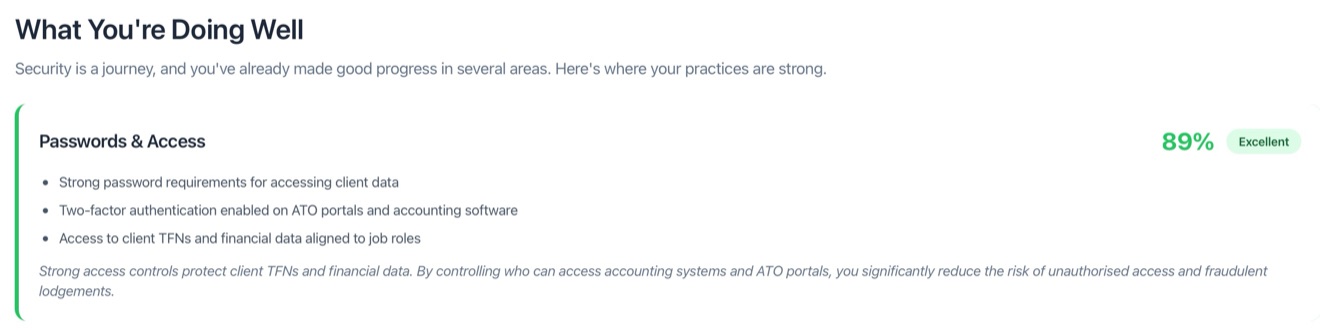
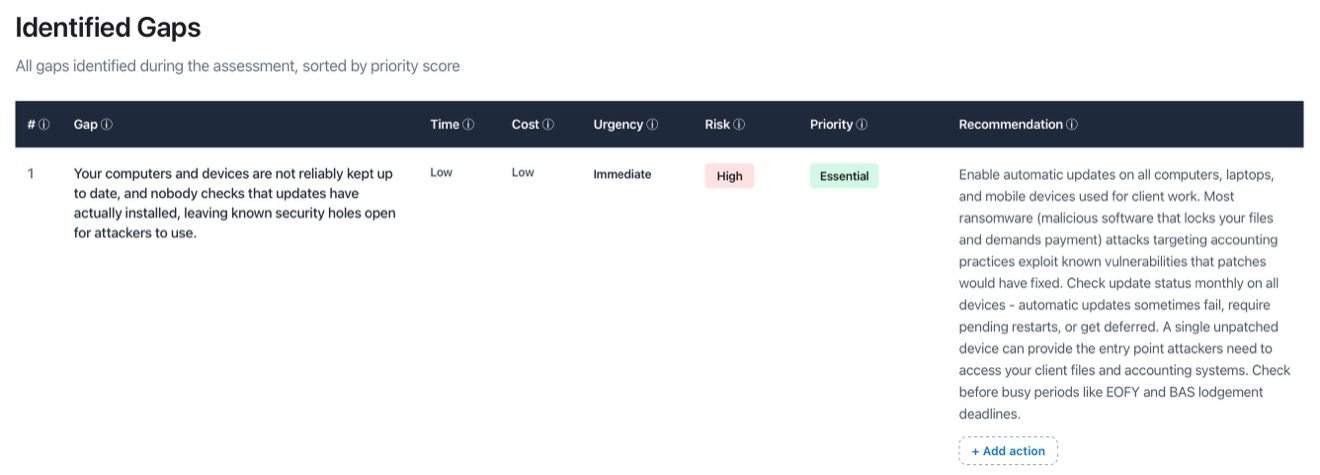
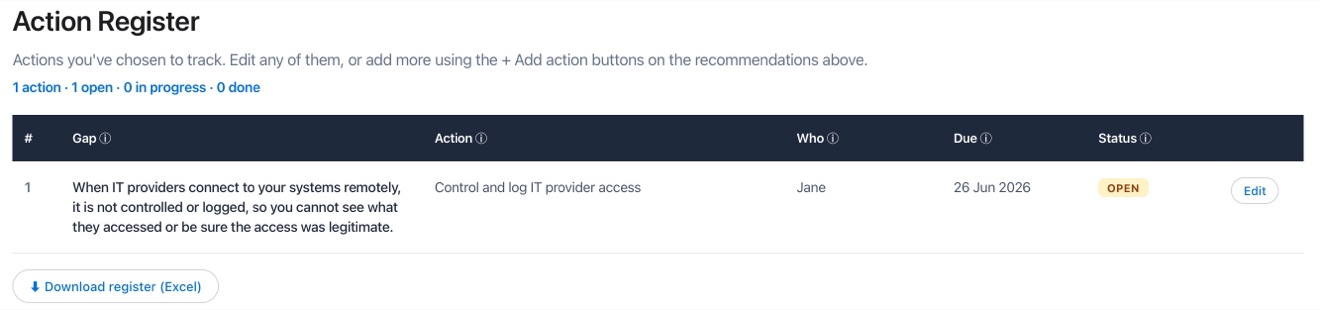
Finish in about an hour and you get a clear overall score, a breakdown across every security domain, and every gap turned into a prioritised action plan you can track and export. (Example output.)
What You Receive
Every assessment generates a comprehensive report. Download a sample below.
Summary Report
Plain-English findings with scores, prioritised improvement plan, risk associations, and resources
Download SampleComplete it in about 60 minutes. No technical knowledge required. Your data never leaves your device.
Who is this for?
Sole practitioners, small partnerships, and boutique law firms. Principals and practice managers responsible for compliance and risk management. Any legal practice that handles client information and wants to understand their cyber security posture—without needing IT expertise to do it.
Your Assessment Includes a Personal AI Security Advisor
Two AI assistants are built into the tool — one to help you during the assessment, one to help you make sense of your results. Like having a security professional on call.
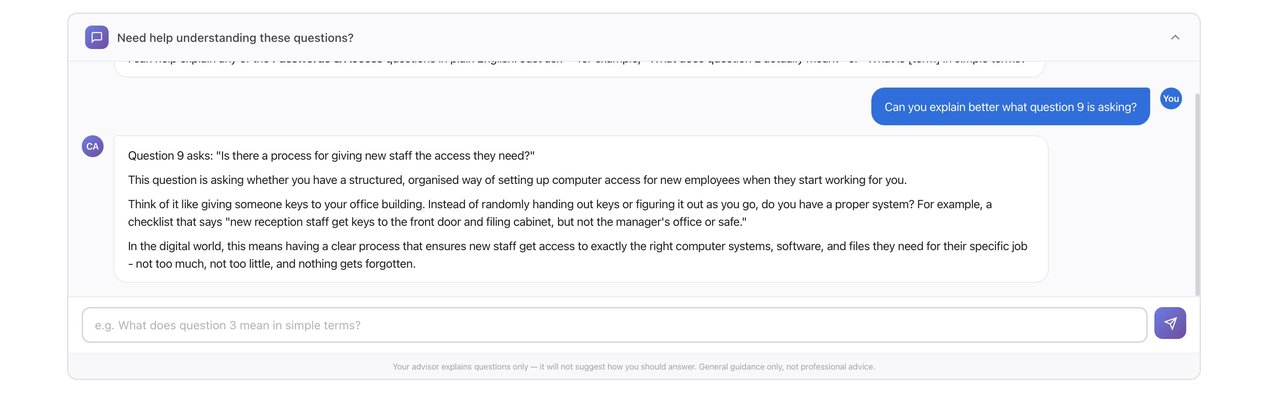
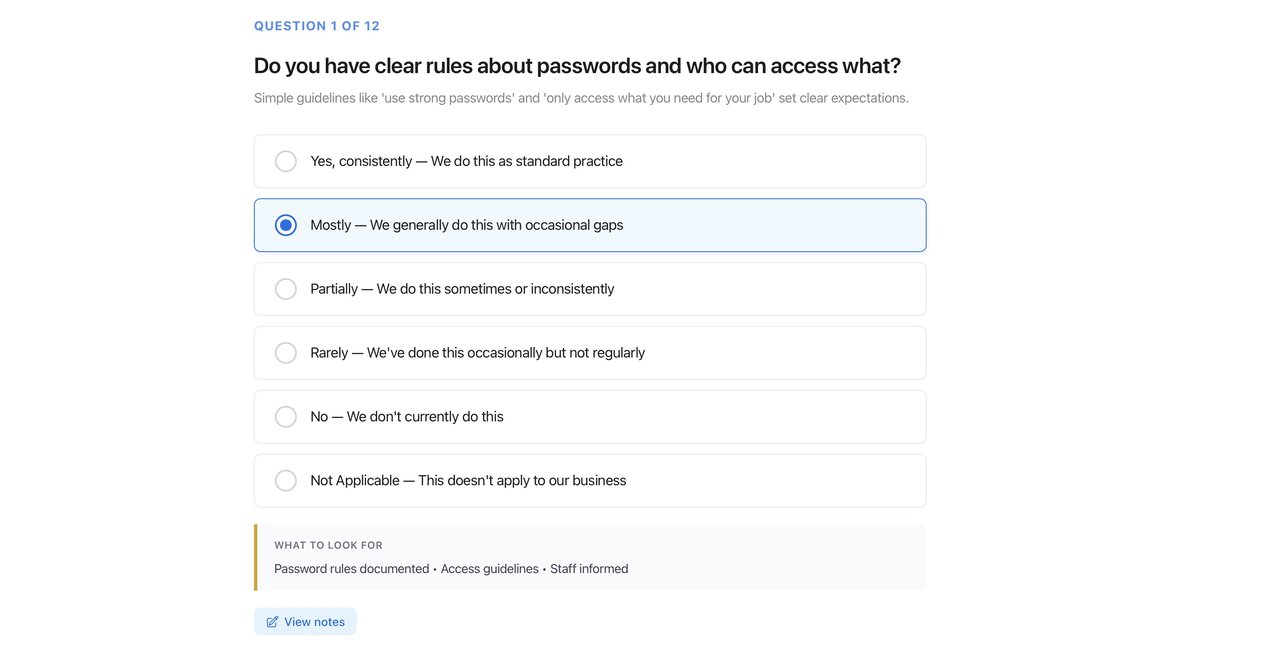
Not sure what a question is asking? Just ask.
Every question in the assessment has an AI helper built in. Tap it and ask anything — "What does this question actually mean?", "Can you give me an example?", "Why does this matter for my business?" — and you'll get a plain-English explanation instantly.
- ✓ Explains technical concepts in everyday language
- ✓ Gives real-world examples relevant to your industry
- ✓ Never suggests how to answer — just helps you understand
- ✓ No technical background required to complete the assessment
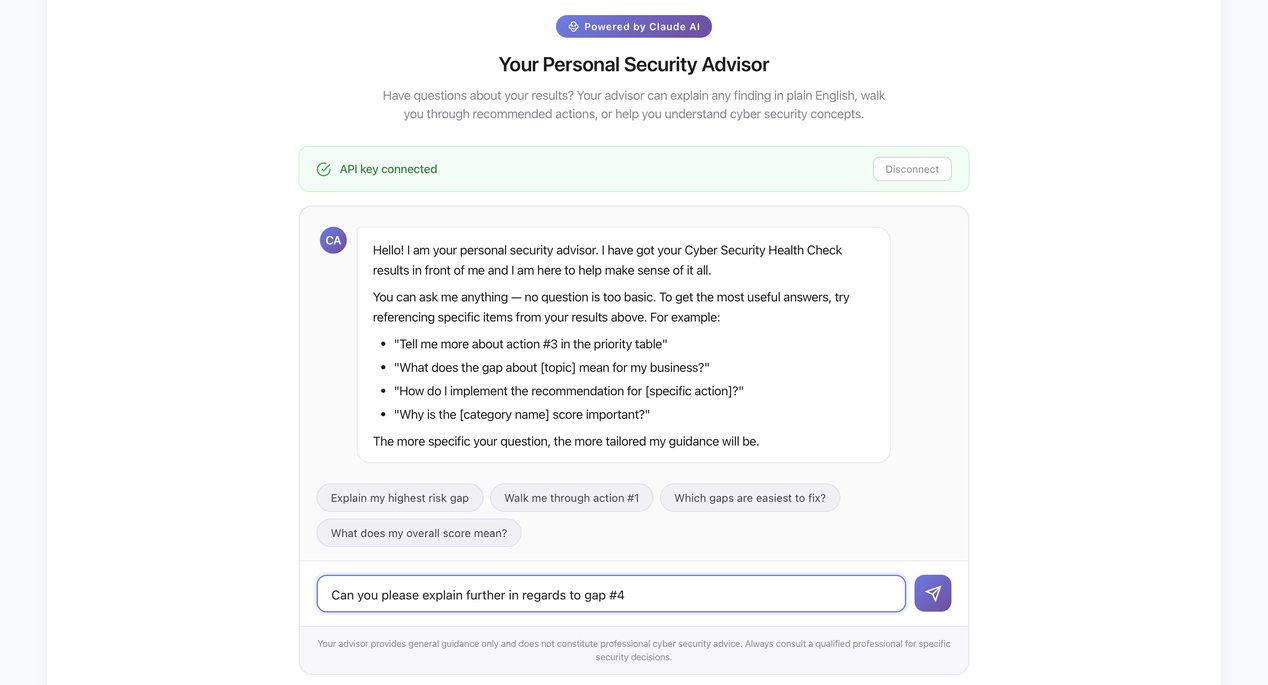
Available the moment you see your results.
Once your results are in, an AI security advisor can answer any question about what they mean — in plain English, like talking to a security professional. It can even draft a phased action plan from your specific gaps — what to fix first, next, and over time.
- ✓ "Explain my highest risk gap in simple terms"
- ✓ "Walk me through how to fix action #3"
- ✓ "Which gaps are easiest to fix myself?"
- ✓ Ask anything — your advisor knows your specific results
Get the Legal Practice Cyber Health Check
Register your interestCommon Questions
Why are law firms and legal practices targeted by cyber criminals?
What regulatory obligations apply to law firms regarding cyber security?
What does the Law Firm Health Check cover?
What do I receive after completing the health check?
Further Reading
Resource
Cyber Security for Law Firms and Legal Practices
Why law firms face trust account fraud and BEC attacks, what the Law Society requires, and the controls that protect client confidentiality and funds.
Read the guide